Health and Safety Policy for Office Clearance Honor Oak
Purpose: This policy sets out the health and safety commitments and systems that govern our office clearance and rubbish removal activities. It applies to all staff, contractors and others who may be affected by our operations in the service area, and to any work carried out under the banner of Honor Oak office clearance or related commercial clearance services. The aim is to deliver safe, legal and environmentally responsible clearance of offices, storage rooms and light commercial premises with minimal risk to people and property.Scope and Objectives
This document covers the planning and delivery of office clearance, rubbish clearance services and related waste handling tasks. Objectives include preventing injury, controlling occupational health risks, ensuring safe handling and transportation of waste, and maintaining clear responsibilities for safety performance. The policy supports continuous improvement in safety standards and effective communication of hazards, without prescribing specific local legal detail.
Management Responsibilities
Management shall provide leadership and adequate resources to implement this policy. Key responsibilities include:- Developing and maintaining risk assessments for every clearance project.
- Providing appropriate training and personal protective equipment (PPE).
- Ensuring safe systems of work for rubbish removal, furniture dismantling and recycling segregation.
- Monitoring contractor performance for any subcontracted clearance tasks.
Risk Assessment and Control Measures
All operational jobs require documented risk assessments prior to commencement. Assessments identify hazards such as manual handling, sharps or contaminated materials, trip and fall risks, vehicle loading/unloading, and possible asbestos or hazardous substances encountered during clearance. Control measures include safe lifting techniques, mechanical aids, segregation of waste streams, and clear signage. We use conservative assumptions and a hierarchy of control: eliminate, substitute, engineer, administrate and use PPE as a last resort for residual risk control.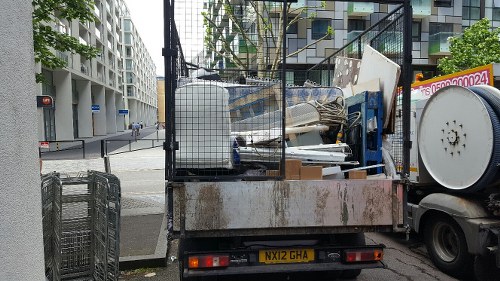
Operational Procedures and Safe Working Practices
Day-to-day operations for an office clearance team follow defined procedures: job briefings, risk brief, correct use of equipment, and methodical waste separation for recycling and disposal. Crews use trolleys, sack trucks, lifting straps and protective clothing as needed. Rubbish collection and rubbish removal tasks are planned to avoid lone working in risky situations; where lone working is unavoidable, additional safeguards and check-in systems are in place. Emphasis is placed on preventing injuries from awkward postures, repetitive tasks and sudden exertion.Hazardous Materials and Environmental Controls
Clearance teams are trained to identify potentially hazardous materials and to stop work and escalate if such items are encountered. This includes suspect asbestos-containing materials, chemical containers, and electrical equipment with batteries or capacitors. Appropriate containment, labeling and handover to licensed specialists are mandated. Spill kits and containment measures are available to control leaks and prevent pollution while maintaining the safety of the workforce and third parties.Training, Competence and Communication
Personnel engaged in office and commercial clearance shall receive induction training specific to clearance work. Refresher training, toolbox talks and job-specific briefings ensure competence in manual handling, use of mechanical lifting aids, vehicle loading protocols and the correct disposal routes for different waste types. Communication channels encourage staff to report hazards, suggest improvements and participate in safety reviews. Records of training and competence assessments shall be maintained and reviewed periodically.
Equipment, Vehicles and Maintenance
Equipment and transport used in clearance operations are maintained to a high standard and inspected regularly. Vehicle checks include secure load restraints, functioning tail lifts, lighting and braking systems. Stationary equipment such as compactors, balers or power tools are guarded and serviced on schedules. Any defects are reported and the item is removed from service until repaired. Safe loading practices avoid overloading and ensure clear access and egress routes during removal operations.